
Sanitation Without Steam.
Cold-Water Cage Washing
With Validation.
Quip Laboratories' house-hot water cage wash program eliminates the 180°F rinse requirement, cuts cycle times dramatically, and delivers validated sanitation using Quiptrol® 3000 chemistry. No steam heating. No cooldown water waste.
What Is House-Hot Water Washing?
"House-hot water" washing — also called cold-water washing — refers to cage wash programs that use only the hot water already available throughout a facility. No booster heaters. No steam generation. No waiting for the machine to reach temperature.
Traditional cage wash programs require water heated to 140°–160°F during the wash cycle, with a rinse temperature of 180°F or above. With Quip Labs' cold-water wash program, facilities achieve validated sanitation at ≤130°F — eliminating that 180°F rinse requirement entirely.
Where Conventional Washing Burns Your Budget
Time
Roughly 50% of a standard cage wash cycle is spent getting water to temperature — not cleaning. On average, a hot-water wash cycle runs 35 minutes or longer.
Energy
Heating wash water to sanitation temperatures requires approximately 48,000 BTUs per cycle. Multiply that across daily runs and the cost is substantial.
Water
Facility drains have a 140°F temperature limit. After a 180°F rinse, cold water must be added to bring drain discharge to acceptable temperature. That's water used for undoing heat, not washing.
Traditional Hot-Water vs. Cold-Water Program
| Traditional Hot-Water Wash | Quip Labs Cold-Water Program | |
|---|---|---|
| Rinse Temperature | 180°F or above | ≤130°F |
| Average Cycle Time | 35+ minutes | Reduced by nearly half |
| Energy per Cycle | ~48,000 BTUs (steam heating required) | No steam heating required |
| Drain Cooldown Water | Required — cold water added post-rinse | Not needed — stays within drain limits |
| Sanitation Validation | Temperature tapes | ATP testing — direct measurement of surface cleanliness |
Sources: Quip Laboratories internal data.
How It Works: Quiptrol® 3000 in the Final Rinse
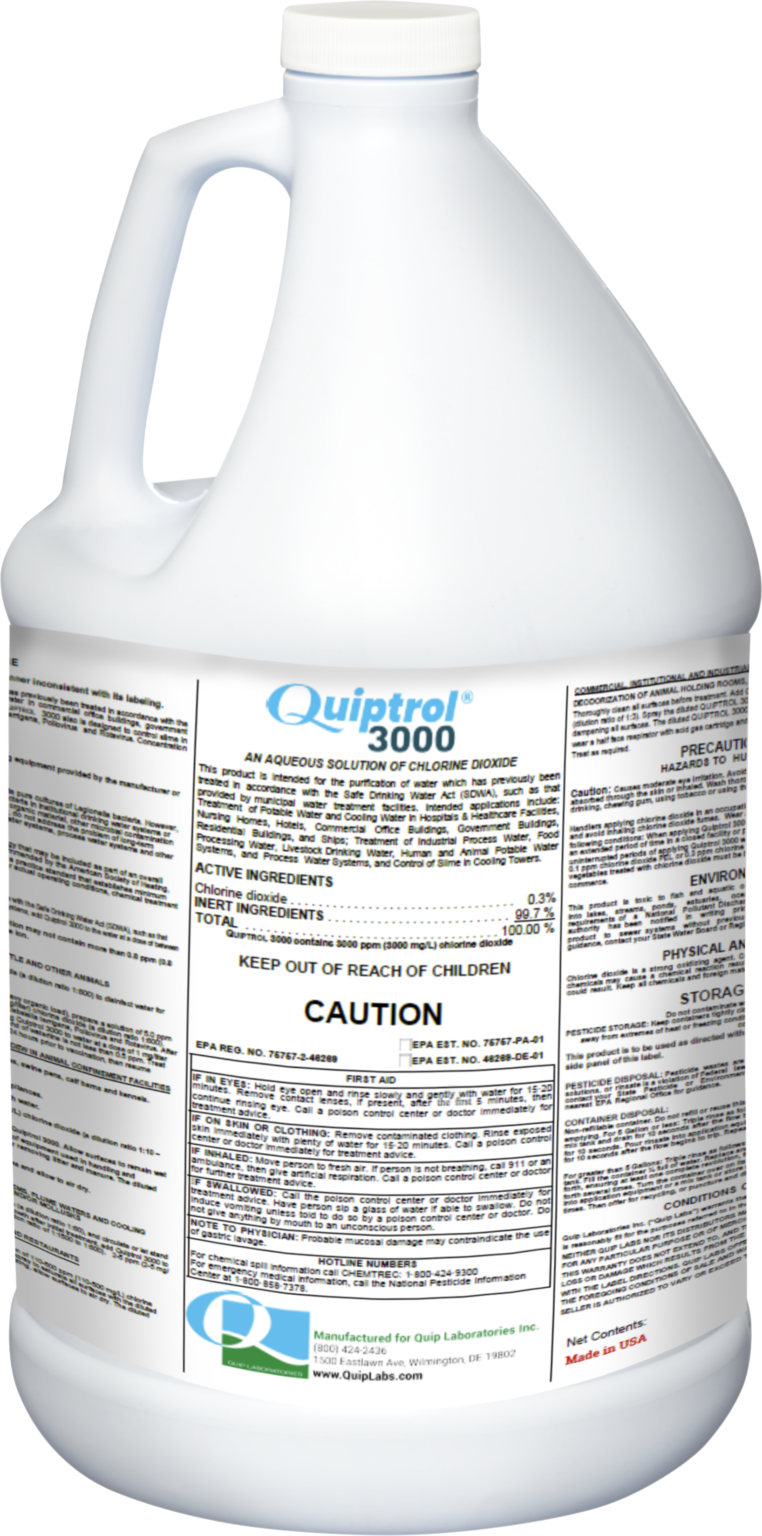
The shift from 180°F rinse sanitation to cold-water sanitation depends on one key product: Quiptrol® 3000, an EPA-registered aqueous chlorine dioxide solution (EPA Reg. No. 75757-2-46269).
Rather than relying on heat to achieve sanitation, the program relies on validated chemistry. Quiptrol 3000 is an effective oxidant and biocide at relatively low concentrations and is added to the final rinse in place of high-temperature water.
Because the mechanism of sanitation changes, so does the method of validation. Temperature tapes no longer apply. Facilities validate sanitation using ATP testing — which measures organic load on surfaces to confirm cleanliness — rather than simply verifying a temperature was reached.
Standard Wash Cycle
Cages run through your existing washer using your current detergent program at house-hot water temperatures.
Quiptrol® 3000 Final Rinse
In the final rinse position, Quiptrol 3000 replaces high-temperature water. Chlorine dioxide chemistry delivers EPA-validated sanitation at ≤130°F.
ATP Validation
Sanitation is confirmed through ATP testing, which measures organic load on surfaces to validate cleanliness — replacing temperature tape validation.
Drain Directly — No Cooldown
Because rinse temps stay within 140°F drain limits from the start, no cold water addition is needed. Drain immediately.
Where Does Your Cycle Time Actually Go?
Toggle between programs to see how much of a standard wash cycle is productive cleaning time versus temperature prep.
Traditional Hot-Water Cage Wash — 35+ Minutes
Quip Labs Cold-Water Program — Cycle Time Reduced by ~Half
Benefits at a Glance
No 180°F Rinse Requirement
Eliminate steam heating infrastructure and the ongoing energy costs that come with it.
No Cooldown Water Waste
The program operates within 140°F drain limits from the start — no cold water addition needed after the rinse.
ATP Validation
ATP testing measures organic load on surfaces to validate cleanliness — a more direct confirmation of sanitation than verifying a temperature was reached.
Operational During Steam Downtime
Scheduled or unscheduled outage, cage washing doesn't stop when steam infrastructure goes down.
Faster Cycle Times
Eliminating temperature prep cuts cycle time by roughly half, increasing washing throughput.
Broad Equipment Compatibility
Compatible with rack, cabinet, and tunnel washers — no equipment replacement required.
Two Ways to Implement
Full Program Conversion
Some facilities convert their entire cage wash program to cold-water washing and never return to steam. The cold-water program becomes the standard, with ATP validation replacing temperature tapes facility-wide.
On-Site Contingency
Other facilities keep their existing steam program and add Quiptrol 3000 on-site as a contingency — ready to deploy when steam goes down, planned or otherwise. The validation method and chemistry are identical in either case.
Signs Your Facility Should Evaluate This Program
- Managing aging steam infrastructure
- Dealing with energy audits or sustainability reporting requirements
- Facing drain temperature restrictions
- Looking for a more reliable way to validate cage wash sanitation
- Experiencing frequent steam outages that interrupt cage wash schedules
- Seeking to increase throughput without adding equipment
Equipment Compatibility
Talk to a Quip Labs biosafety account manager to confirm whether your current setup supports the program.
Frequently Asked Questions
Ready to Evaluate a Cold-Water Program?
Talk to a Quip Labs biosafety account manager to find out if your current setup supports the program and to get an estimate of potential savings at your facility.
Get in Touch
Reach out to discuss your facility's cage wash program and whether cold-water washing is a fit.
Need a quote? Ready to order? Just want to say hi? Fill out the form!
"*" indicates required fields