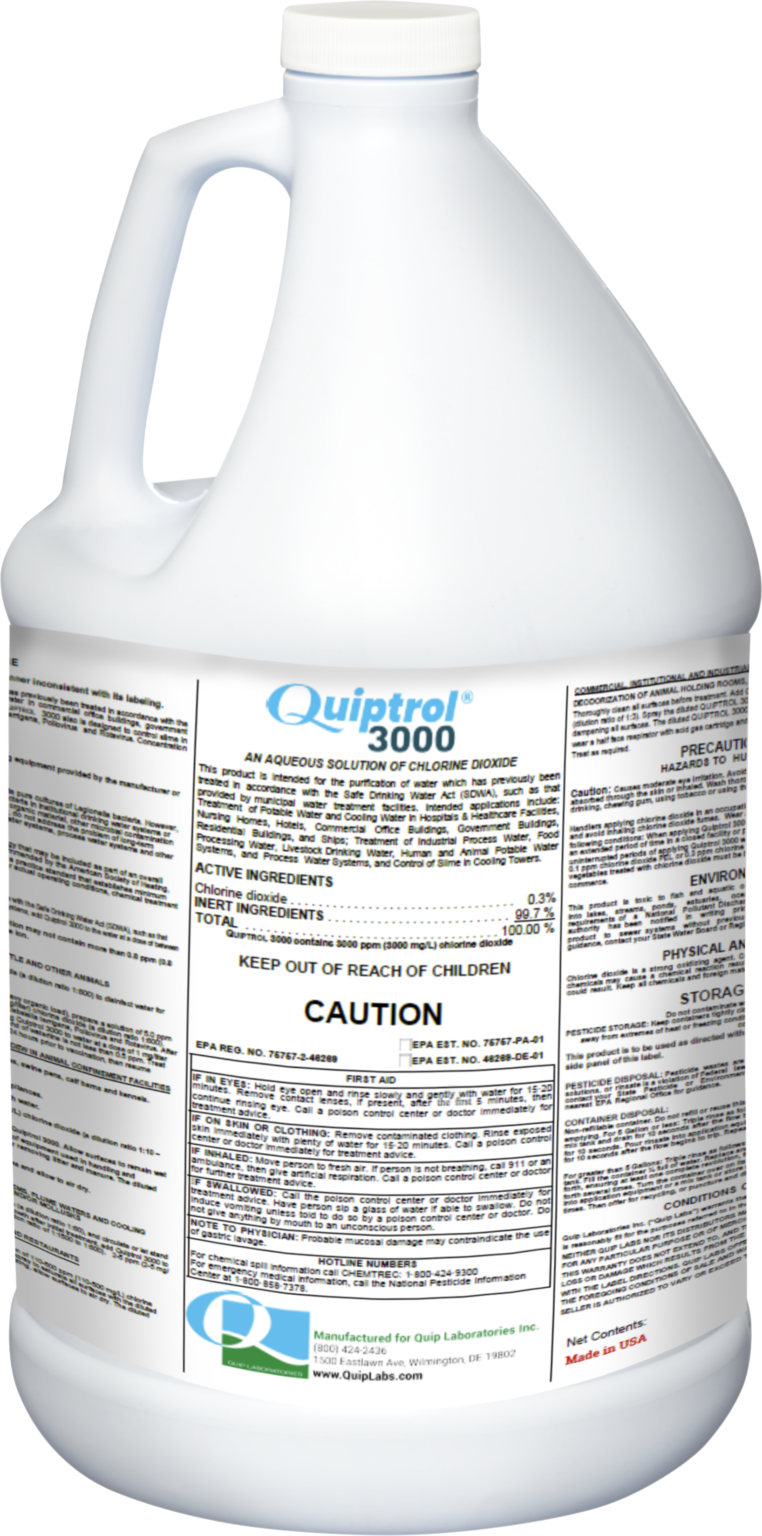
Quiptrol 3000 | Chlorine Dioxide Water Treatment Disinfectant

What To Know About This Product
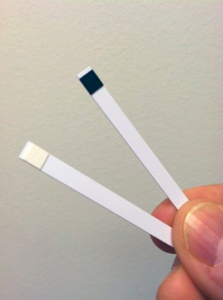
Residual of 0.5–3 ppm (0.5–3.0 mg/L) chlorine dioxide for fruit and vegetable washes
Overview
This product is intended for the purification of water which has previously been treated in accordance with the Safe Drinking Water Act (SDWA), such as that provided by municipal water treatment facilities.
Intended applications include: treatment of potable water and cooling water in hospitals & healthcare facilities, nursing homes, hotels, commercial office buildings, government buildings, residential buildings, and ships; treatment of industrial process water, food processing water, livestock drinking water, human and animal potable water systems, and process water systems; and control of slime in cooling towers.
Product Registration
This product is registered with the U.S. EPA under the Federal Insecticide, Fungicide, and Rodenticide Act (FIFRA).
Note: Content on this page is limited to language found on the EPA-accepted master label. Certifications or standards not stated on the label (e.g., NSF/ANSI 60) are not represented here pending confirmation against the current accepted Quiptrol 3000 label/CSF.
Dosing Guidelines: Potable Water
This product is intended for use to treat water which has been previously treated in accordance with the Safe Drinking Water Act (SDWA), such as that provided by municipal water treatment facilities. For most municipal and other potable water systems, add this product to the water at a dose of between 1.5 ppm (1.5 mg/L) and 2.0 ppm (2.0 mg/L) chlorine dioxide (a dilution ratio 1:2000 to 1:1500). Under US EPA regulations, drinking water intended for human consumption may not contain more than 0.8 ppm (0.8 mg/L) residual chlorine dioxide and no more than 1.0 ppm (1.0 mg/L) chlorite ion.
Dosing Guidelines: Animal Drinking Water
Add this product to the water at a maximum dose of 5.0 ppm (5.0 mg/L) chlorine dioxide (a dilution ratio 1:600) to disinfect water for animal consumption. If the water supply has heavy contamination (e.g. highly turbid, discolored, heavy organic load), prepare a solution of 5.0 ppm chlorine dioxide by adding this product to water at a dose of 5.0 ppm (5.0 mg/L) chlorine dioxide (a dilution ratio 1:600). Allow 15 minutes before delivery to poultry. After 24 hours, the addition rate can be reduced to 1 ppm (1 mg/L) chlorine dioxide (a dilution ratio of 1:3000), as long as terminal concentration at the end of the waterline is not less than 0.5 ppm (0.5 mg/L). Treat water continuously from day one. Remove this product from drinking water 24 hours prior to vaccination, then resume treatment 24 hours after vaccinations.
Dosing Guidelines: Fruit and Vegetable Wash
When used as a fruit and vegetable wash or spray, add this product to water at a maximum dose of 100 ppm (100 mg/L) chlorine dioxide (a dilution ratio of 1:30) to achieve a residual of between 0.5 and 3 ppm (0.5 and 3.0 mg/L) chlorine dioxide. Adjust feed dosage to maintain residual measured immediately following the spray or dip solution immersion. A potable water rinse is not required for those fruits and vegetables that are not further processed by blanching, cooking, or canning.
Always follow the current EPA-accepted product label for exact dosing, equipment, and handling instructions. It is a violation of federal law to use this product in a manner inconsistent with its labeling.
Water Treatment Shouldn't Be a Research Variable
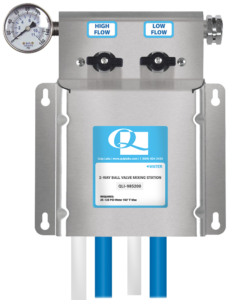
Quiptrol 3000 is most often dosed through PurityGard®, Quip Laboratories' continuous water treatment program. PurityGard® replaces manual dosing and variable water quality with automatic, continuously dosed systems built and serviced around your facility.
Frequently Asked Questions
Per label directions, intended applications include treatment of potable water and cooling water in hospitals & healthcare facilities, nursing homes, hotels, commercial office buildings, government buildings, residential buildings, and ships; treatment of industrial process water, food processing water, livestock drinking water, human and animal potable water systems, and process water systems; and control of slime in cooling towers.
Label directions specify a dose of 1.5–2.0 ppm chlorine dioxide for most municipal and other potable water systems, a maximum dose of 5.0 ppm chlorine dioxide for animal drinking water, and a maximum dose of 100 ppm chlorine dioxide (to achieve a 0.5–3 ppm residual) for fruit and vegetable washes. Drinking water intended for human consumption may not contain more than 0.8 ppm residual chlorine dioxide or more than 1.0 ppm chlorite ion under US EPA regulations. Always follow the current EPA-accepted label for application-specific instructions.
Label directions for water treatment applications specify use of a chemical feed pump or injector system to add this product to make-up water and maintain the specified dose or residual, per the application-specific directions on the label.
Per label directions, this product is added to water at a maximum dose of 5.0 ppm chlorine dioxide to disinfect water for animal consumption, with a stepped-down dosing protocol for heavily contaminated water supplies and a required 24-hour withdrawal period before and after vaccination. Always follow the current EPA-accepted label directions for exact dosing and handling.
Need More Help With Your Chemicals?
Fill out the form below to get connected to a Biosafety Account Manager now.
Need a quote? Ready to order? Just want to say hi? Fill out the form!
"*" indicates required fields