
What is “Integrated” Facility Hygiene?
The landscape of biomedical research facilities has changed dramatically in recent years, with unprecedented challenges including budget constraints from indirect funding caps, staffing limitations due to hiring freezes, increasing compliance requirements, and supply chain vulnerabilities. In this constrained environment, the traditional approach of addressing sanitation needs through disconnected components—separate vendors for cage wash chemistries and equipment, different suppliers for disinfection products, independent water treatment systems, and standalone monitoring programs—has become increasingly problematic.
While this fragmentation may have made sense in the past, this disjointed approach now creates significant hidden costs and inefficiencies for today’s resource-constrained facilities. Today, efficiency isn’t just a goal—it’s a necessity for survival.
Quip Labs partners with life science institutions to streamline hygiene operations through integrated sanitation systems, validated products, equipment support, and on-site service. Our model replaces fragmented solutions with a comprehensive strategy that enhances performance, compliance, and cost control.
The Hidden Costs of Fragmentation
The traditional siloed approach to facility hygiene creates numerous inefficiencies:
- Chemical Incompatibility: Products and process working against each other, potentially causing equipment damage or residue issues that can impact research outcomes
- Operational Inefficiency: Multiple systems, processes, and protocols requiring additional staff time and training
- Data Isolation: Critical information trapped with separate vendors, making facility-wide insights impossible
- Administrative Burden: Managing multiple vendors and relationships, consuming valuable administrative resources
- Inconsistent Service: Variable response times and support levels across different vendors
The research facility marketplace includes many vendors with limited offerings. Examples of these are disinfection-only providers focused exclusively on a specific chemistry, equipment-only vendors with no chemistry expertise, and decontamination providers that don’t regularly visit your facilities. When vendors have limited offerings, they’re inherently constrained in their recommendations. As the old saying goes: “Every problem looks like a nail when your only tool is a hammer.”
The Four Pillars of an Integrated System
A truly integrated approach to vivarium sanitation is built on four essential pillars:
Scientific
Standardized protocols and validated procedures to protect research reproducibility.
Learn MoreOperational
Streamlined workflows and SOPs to reduce administrative overhead and errors.
Learn MoreFinancial
Integrated programs consistently deliver 20–40% savings over siloed systems.
Learn MoreDecisionmaking
Comprehensive monitoring identifies patterns that remain hidden in isolated systems.
Learn MoreThe Service Difference: We Show Up
Integration alone is not enough.
Without reliable, on-site support, even the best-integrated systems can fall short. In fact, partnering with a “full-service” vendor that doesn’t provide consistent service can be worse than using multiple providers—you lose both responsiveness and flexibility. At Quip Labs, service excellence is foundational to our approach. Our Biosafety Account Managers have received Vendor of the Year recognition from multiple AALAS branches—because we consistently show up, solve problems, and take ownership.
Our service model includes:
- Scheduled preventative maintenance (not just emergency response)
- 28-point LAS Reports by dedicated technicians who understand your systems
- Routine validation and monitoring, not occasional check-ins
In one facility, our team discovered misdosed solid cage wash chemicals causing a persistent white buildup in hoses and down walls—an issue overlooked by the previous vendor who failed to inspect post-installation.
These details matter. Missed problems like this shorten equipment life, increase residue risks, and undermine research validity.
Why Integration Matters Now More Than Ever
As financial and operational pressures mount, fragmentation becomes increasingly unsustainable.
A well-integrated hygiene program—backed by consistent service—improves outcomes, supports compliance, and reduces both cost and burden on internal teams. By evaluating your full hygiene program rather than isolated components, we identify synergies that increase performance and reduce waste. Our broad product and service portfolio enables us to recommend the right solutions—not just the ones we happen to sell.
Continue Your Integrated Facility Management Journey
The integration principles we've discussed for vivarium sanitation apply broadly across facility operations—including chemical management programs.
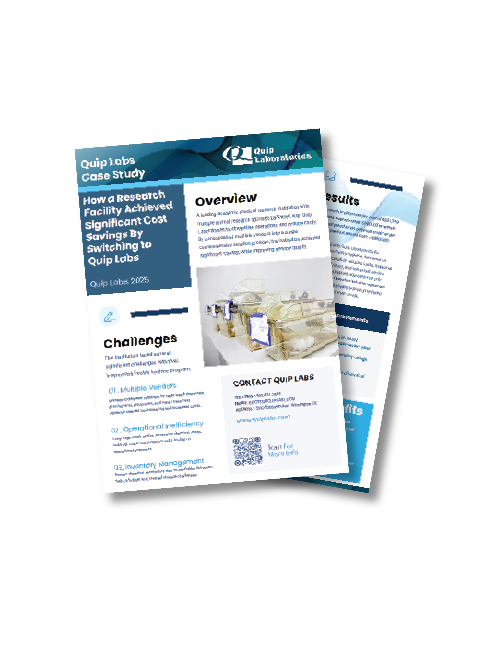
This case study documents how a leading life sciences organization implemented our MaestroChem™ program to address challenges similar to those faced by research vivariums:
- Documented 39% reduction in total program costs
- Decreased water consumption and chemical waste
- Minimized on-site inventory requirements
- Enhanced service coordination and accountability
See the specific implementation strategies and detailed results that can be applied to your own facility management approach.
Complete the form to unlock
Get the Complete Case Study
Fill out the form to get access to this case study now!
Get Access Now!
Want to learn more? Fill out the form to get access now!