Vimoba Tablets | Chlorine Dioxide Tablets For Clinical and Research Laboratories


Vimoba Chlorine Dioxide Disinfectant Tablets
Buffered chlorine dioxide tablets, based on the MB-10 formulation, engineered for broad-spectrum efficacy, enhanced soft metal compatibility, and animal welfare. Proven superior to bleach and Accelerated Peroxide Formulations in published studies.
Disinfectant Selection Is More Complex Than Many Research Facilities Realize
When evaluating disinfectants for research facilities, spectrum of activity is only the starting point. The wrong chemistry can damage equipment, create aversive residues that alter animal behavior, and fail when challenged by organic load or spore-forming bacteria. Many facilities discover these limitations only after contamination events or premature equipment replacement.
Published research demonstrates that Vimoba Tablets address operational challenges common to other disinfectants. Studies comparing chlorine dioxide to bleach and Accelerated Peroxide Formulations show significant differences in material compatibility and animal behavioral effects.
Published Evidence from UC San Diego and UCLA
Two peer-reviewed studies evaluated disinfectants across efficacy, material compatibility, and behavioral effects in laboratory animal settings. The findings establish chlorine dioxide tablets as the most effective option when all three factors are considered. View UC San Diego study | View UCLA study
Study protocols may differ from EPA-registered directions for use. Always follow the current EPA master label for application method and contact time.
UC San Diego Gnotobiotic Core Facility Study
Moody et al., Journal of the American Association for Laboratory Animal Science, 2019
- Chlorine dioxide tablets retained efficacy under the study's spore challenge conditions (Moody et al., 2019)
- Accelerated Peroxide Formulations lost 80- to 100-fold efficacy against spores and showed zero sporicidal activity at tested concentrations
- Bleach and the tested peroxide-based product caused visible pitting and fissuring in acrylic after 3-month field testing
- Vimoba Tablets caused no visible material damage to acrylic, vinyl, or metals
Note: The study tested an Accelerated Peroxide Formulation. Material compatibility issues are believed to result from surfactant additives rather than hydrogen peroxide itself. Standard hydrogen peroxide solutions that are not Accelerated Peroxide Formulations show different material compatibility profiles.
UCLA Behavioral Aversion Study
Campagna et al., Journal of the American Association for Laboratory Animal Science, 2016
- Sodium hypochlorite (bleach) created statistically significant aversion across all three mouse strains tested (P < 0.001)
- The tested Accelerated Peroxide Formulation also created statistically significant aversion
- Vimoba Tablets showed no significant aversion in any strain
- The competitor product's aversive component was undetectable to human observers but consistently avoided by mice
- Pre-exposure reduced but did not eliminate aversion, animals did not develop tolerance
Note: The tested product was an Accelerated Peroxide Formulation. Aversive effects are believed to result from surfactant or other proprietary additives rather than hydrogen peroxide itself.
Broad-Spectrum Activity Across Pathogens of Concern
Vimoba Tablets are EPA-registered against the organisms most relevant to laboratory animal facilities, biomedical research, and veterinary settings. All claims listed below are verified through EPA's Antimicrobial Testing Program.
Viruses (100 ppm)
- Avian Influenza A (H3N2)
- Canine Parvovirus
- Foot & Mouth Disease
- Hantavirus
- Infectious Bursal Disease (IBDV)
- Influenza A (Hong Kong)
- Marek's Disease (MDV)
- Minute Virus of Mouse (MVM-i, MVM-p)
- Mouse Hepatitis Virus (MHV-A59, MHV-JHM)
- Murine Parainfluenza Type 1 (Sendai)
- Porcine Circovirus Type 2
- Porcine Respiratory & Reproductive Syndrome (PRRSV)
- Sialodacryoadenitis Virus (SDAV)
- Theiler's Mouse Encephalomyelitis (TMEV)
- Vaccinia
Viruses (200 ppm)
- Feline Panleukopenia
- Hepatitis B
- Hepatitis C
- HIV-1
- Human Coronavirus
- Newcastle Disease
- Norovirus
- Poliovirus Type 1
- Pseudorabies
- SARS-CoV-2 (COVID-19)
- Swine Influenza A
- Transmissible Gastroenteritis
Bacteria (Disinfectant)
- Bordetella bronchiseptica
- Corynebacterium bovis
- Enterococcus faecalis (VRE)
- Escherichia coli O157:H7
- Helicobacter pylori
- Mycobacterium bovis (tuberculocidal)
- Pseudomonas aeruginosa
- Salmonella enterica
- Staphylococcus aureus
- Staphylococcus aureus (MRSA)
Bacteria (Sanitizer - 25 ppm)
- Listeria monocytogenes
- Salmonella enterica
Sterilant (1000 ppm)
EPA-registered sterilant for BSL-3/BSL-4 facilities, pharmaceutical manufacturing, and laboratory equipment requiring complete microbial elimination. One-hour contact time.
Designed for Research, Veterinary, and Biomedical Settings
Laboratory Animal Facilities
Cages, coops, crates, kennels, floors, walls, counters, biosafety hoods, instruments, transfer equipment, gnotobiotic isolators
Animal Rearing & Research Facilities
Hard non-porous surfaces, equipment, glassware, stainless steel, plastics, epoxy floors
Food-Contact Surface Sanitizer
Processing equipment, utensils, dishes, countertops (25 ppm, 60 sec contact time)
Healthcare & Veterinary Facilities
Hospitals, clinics, ambulances, medical/dental offices, surgical instruments
Commercial & Institutional
Office buildings, food plants, schools, hotels, transportation vehicles
Surface Sterilization
BSL-3/BSL-4 facilities, pharmaceutical manufacturing, laboratory equipment (1000 ppm, 1 hour)
Dosing Reference
| Application | Concentration | Contact Time | 1.5 g Tablet | 6.0 g Tablet |
|---|---|---|---|---|
| Sanitizer (food contact) | 25 ppm | 60 seconds | 1 tablet per gallon | 1 tablet per 4 gallons |
| Disinfectant (general) | 100 ppm | 10 minutes* | 4 tablets per gallon | 1 tablet per gallon |
| Disinfectant (higher level) | 200 ppm | 1–10 minutes* | 8 tablets per gallon | 2 tablets per gallon |
| Sterilant | 1000 ppm | 60 minutes | 8 tablets per liter | 8 tablets per gallon |
*Contact time varies by pathogen; 30 minutes for Foot & Mouth Disease Virus. Allow 10 minutes for the 1.5 g tablet and 15 minutes for the 6.0 g tablet to fully dissolve before use. Prepare in a well-ventilated area. Once mixed, store in a tightly covered container and use within 7 days; prepare 1000 ppm solutions fresh daily. See the EPA master label for complete preparation directions.
Material Compatibility in Research Environments
Unlike bleach and Accelerated Peroxide Formulations, chlorine dioxide tablets do not cause pitting, cracking, or corrosion to materials commonly used in research facilities. This difference has been documented in published field testing.
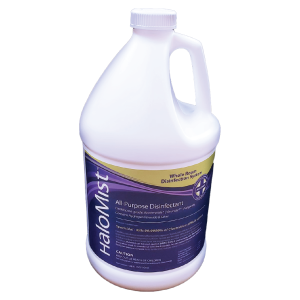
Important: The tested product was an Accelerated Peroxide Formulation. Standard hydrogen peroxide solutions (such as Quip Labs' HaloMist) are not Accelerated Peroxide Formulations and do not exhibit the same material compatibility issues, as damage appears to result from surfactant additives.
Comparison of Material Effects
| Material | Vimoba Tablets | Bleach | Accelerated Peroxide Formulation* |
|---|---|---|---|
| Acrylic (isolator ports) | Greatly reduced risk of damage | Pitting, fissuring | Severe pitting, cracking |
| Polysulfone caging | Compatible when used properly | Compatible | Clouding, cracking |
| Stainless steel | No visible damage in published testing | Corrosive | Compatible |
| Vinyl (isolator film) | No visible damage in published testing | Slight effects | Thick residue |
| Soft metals | Buffered for enhanced compatibility | Highly corrosive | Variable |
*Accelerated Peroxide Formulation tested in published studies. Standard hydrogen peroxide products show different compatibility profiles.
Field Testing Results
In a three-month field test using actual gnotobiotic isolator ports in routine use, the tested Accelerated Peroxide Formulation caused severe material compatibility issues. Chlorine dioxide tablets caused no visible damage. (UC San Diego study, 2019)
No Behavioral Aversion: A Critical Advantage for Research
The Problem
Disinfectant residues can create aversive odors that animals perceive but humans cannot detect. When animals avoid treated surfaces, facilities introduce an uncontrolled variable into housing, handling, and behavioral testing, one that protocols don't account for.
UCLA Study Results
Statistically significant aversion across all three mouse strains tested (Swiss Webster, C57Bl/6, BALB/c). P < 0.001.
Statistically significant aversion. The tested product's aversive component was undetectable to human observers, no noticeable odor, no visible residue, but mice consistently avoided treated surfaces.
The aversive effects are believed to result from surfactant or other proprietary additives in the accelerated formulation, not from hydrogen peroxide itself.
No significant aversion in any strain. No pre-exposure conditioning needed.
Mice pre-exposed to the competitor disinfectant for 15 minutes daily for three consecutive days still showed aversion. The effect persists: animals do not develop tolerance.
Implication for Research
If animals avoid contact with treated surfaces due to sensory perception researchers can't detect, behavioral observations change without documentation. Vimoba Tablets eliminate this confounding variable.
Why Leading Research Facilities Choose Vimoba Tablets
| Factor | Vimoba Tablets | Bleach | Accelerated Peroxide Formulation* | Peracetic Acid |
|---|---|---|---|---|
| EPA Sterilant Registration | Yes — 1000 ppm, 60 minutes | No | Limited formulations | Yes (some formulations) |
| Material Compatibility | No visible damage in published 3-month field testing | Corrosive to metals, damages acrylic | Severe acrylic damage, polysulfone clouding | Variable |
| Animal Aversion | No significant aversion in published testing | Significant (P<0.001) | Significant (P<0.001) | Not tested |
| Odor | Low odor | Strong, offensive | Typically mild to humans** | Strong, vinegar-like |
*Accelerated Peroxide Formulation tested in referenced studies. Standard hydrogen peroxide products (such as Quip Labs' HaloMist) are not Accelerated Peroxide Formulations and show different performance characteristics.
**Aversive to mice despite being imperceptible to humans, believed to result from surfactant additives.
Technical Documentation
UCLA Behavioral Study
Factors in the Selection of Surface Disinfectants for Laboratory Animal Settings
Read StudyMaterials Compatibility Study
Sensible Science: Compatibility benefits of chlorine dioxide tablets with stainless steel
Download PDFReady to Experience the Vimoba Difference?
Get a quote for Vimoba Tablets or explore our complete line of chlorine dioxide solutions, liquid disinfectants, cage wash detergents, and lab services designed for research facilities, veterinary hospitals, and animal care operations.
Send us a message
Need a quote? Ready to order? Just want to say hi? Fill out the form!
"*" indicates required fields