Gnotobiotics Products for Germ-Free Research

Gnotobiotic & Germ-Free Research

Chlorine Dioxide Disinfectants for Gnotobiotic Isolators & Germ-Free Facilities

EPA-registered chlorine dioxide disinfectants and sterilants for gnotobiotic rodent isolators, germ-free mouse facilities, and laboratory animal research programs — with specific efficacy claims against Minute Virus of Mice, Mouse Hepatitis Virus, bacterial spores, and other critical pathogens.

Browse EPA-Registered Products

Peer-Reviewed Research

Disinfection Science for Gnotobiotic Rodent Facilities

Maintaining a germ-free or gnotobiotic animal colony requires disinfectants validated for the specific demands of isolator sterilization — sporicidal efficacy, compatibility with acrylic and vinyl isolator materials, and reliable performance across fogging and immersion applications. The following study is the most rigorous published evaluation of disinfectant classes for this application.

Peer-Reviewed · JAALAS · September 2019

Evaluation of Peroxides and Chlorine Oxides as Disinfectants for Chemical Sterilization of Gnotobiotic Rodent Isolators

Published by researchers at the University of California, San Diego, this study directly compared six disinfectants — representing both chlorine oxide and peroxide classes — for effectiveness in gnotobiotic rodent isolator applications. Testing included suspension kill assays against real contamination isolates, fogging field trials inside live gnotobiotic isolators, and corrosion testing of isolator materials including acrylic and ferrous metals.

Test organisms were drawn from actual isolator breach events at a gnotobiotic core facility, including spore-forming Paenibacillus and Bacillus species and Micrococcus luteus — organisms representative of real-world contamination risk.

Moody LV, Miyamoto Y, Ang J, Richter PJ, Eckmann L  ·  Journal of the American Association for Laboratory Animal Science  ·  Vol 58, No. 5, pp. 558–568  ·  DOI: 10.30802/AALAS-JAALAS-18-000130  ·  University of California, San Diego

Read the full study summary →
Study Design

Six disinfectants from two chemical classes (chlorine oxides and peroxides) were evaluated using suspension cultures, gnotobiotic isolator fogging field tests, and corrosion analysis of materials common to flexible-film isolator construction.

On Bactericidal & Sporicidal Efficacy

Evaluation of bactericidal and sporicidal activity in liquid cultures revealed that chlorine oxide-based disinfectants were more effective than peroxide-based disinfectants. Effectiveness was contact-time dependent across both classes.

On Material Compatibility

Both classes were evaluated for corrosive effects on ferrous metals and acrylic — materials central to isolator transfer ports and rigid components. Some disinfectants in both classes showed excessive corrosive potential in this application.

Overall Conclusion

No single disinfectant possessed all desirable properties. However, chlorine oxide-based disinfectants were generally more effective and less corrosive than peroxide-based products for gnotobiotic isolator sterilization.

Find the Right EPA-Registered Sterilant or Disinfectant for Your Facility

Use the product filter below to search and sort our full line of EPA-registered chlorine dioxide disinfectants and sterilants by application, format, and pathogen coverage.

Browse Products Below
Recommended Products

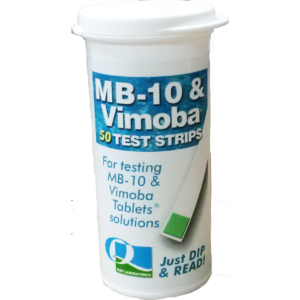
MB-10 Tablets & Vimoba Tablets: Validated Chlorine Dioxide for Gnotobiotic Use

Both products deliver EPA-registered chlorine dioxide disinfection in formats designed for the workflow demands of gnotobiotic and germ-free research facilities. MB-10 and Vimoba Tablets share an EPA registration number and the same active chemistry — each evaluated in peer-reviewed research for this specific application.

Tablet Format

MB-10 Tablets

EPA Reg. No. 70060-19  ·  Chlorine Dioxide Disinfectant / Sterilant

An effervescent tablet that dissolves in water to produce a ready-to-use chlorine dioxide solution. No two-part mixing, no liquid shipping. Solution remains effective for up to seven days once prepared.

  • Minute Virus of Mice (MVM) at 100 ppm
  • Mouse Hepatitis Virus (MHV) at 100 ppm
  • Mouse Parvovirus type 1 (MPV-1) at 100 ppm
  • Murine Parainfluenza virus type 1 (Sendai) at 100 ppm
  • Sialodacryoadenitis virus (SDAV) at 100 ppm
  • Sporicidal sterilant claims at higher concentration

  • EPA List N — Emerging Viral Pathogen claim
Shared EPA Registration: MB-10 Tablets and Vimoba Tablets share EPA Reg. No. 70060-19 and the same active chlorine dioxide chemistry. The primary difference is formulation: Vimoba Tablets include a buffer that provides added compatibility with soft metals such as brass.
View MB-10 Tablets →
Tablet Format

Vimoba Tablets

EPA Reg. No. 70060-19  ·  Buffered Chlorine Dioxide Disinfectant / Sterilant

The same EPA-registered chlorine dioxide chemistry as MB-10, with an added buffer formulated for facilities where equipment includes brass fittings, soft metal components, or metal-intensive instrumentation.

  • Identical active chemistry and pathogen coverage to MB-10
  • Buffered formulation for compatibility with brass and soft metals
  • Recognized in published gnotobiotic reference literature (Current Protocols, Oxford University Press)
  • Same tablet convenience — no liquid shipping, no two-part activation
  • Sporicidal sterilant claims at higher concentration
When to choose Vimoba: If your gnotobiotic isolator setup, port hardware, or connected instrumentation includes brass or other soft metal components, Vimoba's buffered formula is the appropriate choice over MB-10.
View Vimoba Tablets →
Peer-Reviewed Research  ·  Behavioral Aversion Study  ·  JAALAS 2016

A UCLA behavioral study (Campagna et al., Journal of the American Association for Laboratory Animal Science, 2016) evaluated olfactory aversion responses in three mouse strains exposed to common disinfectant chemistries. Sodium hypochlorite (bleach) produced statistically significant aversion across all three strains tested (P < 0.001). A surfactant-accelerated peroxide-based formulation also produced statistically significant aversion. Vimoba Tablets showed no significant aversion in any strain tested — including in animals that had been pre-exposed, which did not develop tolerance to the aversive chemistries.

Campagna et al.  ·  UCLA  ·  Journal of the American Association for Laboratory Animal Science  ·  2016

Read the full study summary →
Common Questions

Gnotobiotic & Germ-Free Disinfection: Frequently Asked Questions

Peer-reviewed research published in the Journal of the American Association for Laboratory Animal Science (2019) evaluated six disinfectants across chlorine oxide and peroxide classes in active gnotobiotic rodent isolators. The study found that chlorine oxide-based disinfectants were generally more effective and less corrosive than peroxide-based products for this application. Effectiveness was contact-time dependent across both classes. The full study is available at the link above.
Minute Virus of Mice (MVM) is a non-enveloped parvovirus and one of the most chemically resistant pathogens encountered in rodent research facilities. Unlike enveloped viruses, non-enveloped viruses are not inactivated by quaternary ammonium compounds, alcohols, or many other commonly used disinfectant classes. EPA-registered chlorine dioxide disinfectants with specific non-enveloped virus efficacy claims — including MVM, Mouse Parvovirus (MPV-1), Mouse Hepatitis Virus (MHV), and Sendai virus — are the appropriate choice for rodent facilities requiring coverage of these organisms. Always verify specific pathogen claims on the product EPA registration label.
Gnotobiotic isolators are typically sterilized using EPA-registered sporicidal disinfectants applied to all interior surfaces for a validated contact time. The port chamber is treated before any materials are transferred into the sterile interior. Heat-stable supplies are usually autoclaved. The 2019 JAALAS study (Moody et al., UC San Diego) evaluated multiple application methods — including fogging inside live isolators — across both chlorine oxide and peroxide disinfectant classes. Because application method claims vary by specific product formulation and EPA registration, always verify permitted uses on the product label before use. Contact Quip Laboratories for protocol support and facility-specific SOPs.
Real-world gnotobiotic isolator contamination events most commonly involve spore-forming bacteria from soil or environmental sources. Analysis of isolator breach events in published research identified Paenibacillus species, Bacillus subtilis spores, and Micrococcus luteus as frequently recovered contaminants. Because bacterial spores represent one of the most chemically resistant life forms, sporicidal efficacy at the sterilant level is the essential benchmark when selecting a disinfectant for gnotobiotic applications.
A disinfectant destroys most pathogenic microorganisms on inanimate surfaces but does not reliably eliminate bacterial spores. A sterilant is capable of destroying all microorganisms, including spores, under defined conditions of concentration and contact time. In gnotobiotic applications, sterilant-level activity is the gold standard — particularly for initial isolator setup and decontamination following a suspected breach — because spore-forming bacteria are among the most common and most chemically resistant organisms found in real contamination events. Look for EPA-registered products with explicit sterilant claims and validated sporicidal contact time data.
Material compatibility is a critical selection factor because gnotobiotic isolators incorporate flexible vinyl film, acrylic transfer port components, and ferrous metal hardware. The 2019 JAALAS comparative study evaluated corrosive effects across multiple disinfectant products and found meaningful variation — some products in both chlorine oxide and peroxide classes caused excessive corrosion to acrylic or metals under test conditions. Consulting published compatibility data for a specific product formulation before use on isolator equipment is essential. Product labels and technical data sheets should document compatibility with acrylic, polycarbonate, stainless steel, and vinyl.
Need Help Building a Gnotobiotic Disinfection Program?
Our team provides protocol support, facility-specific SOPs, and disinfectant program recommendations for germ-free and gnotobiotic research cores of all sizes.