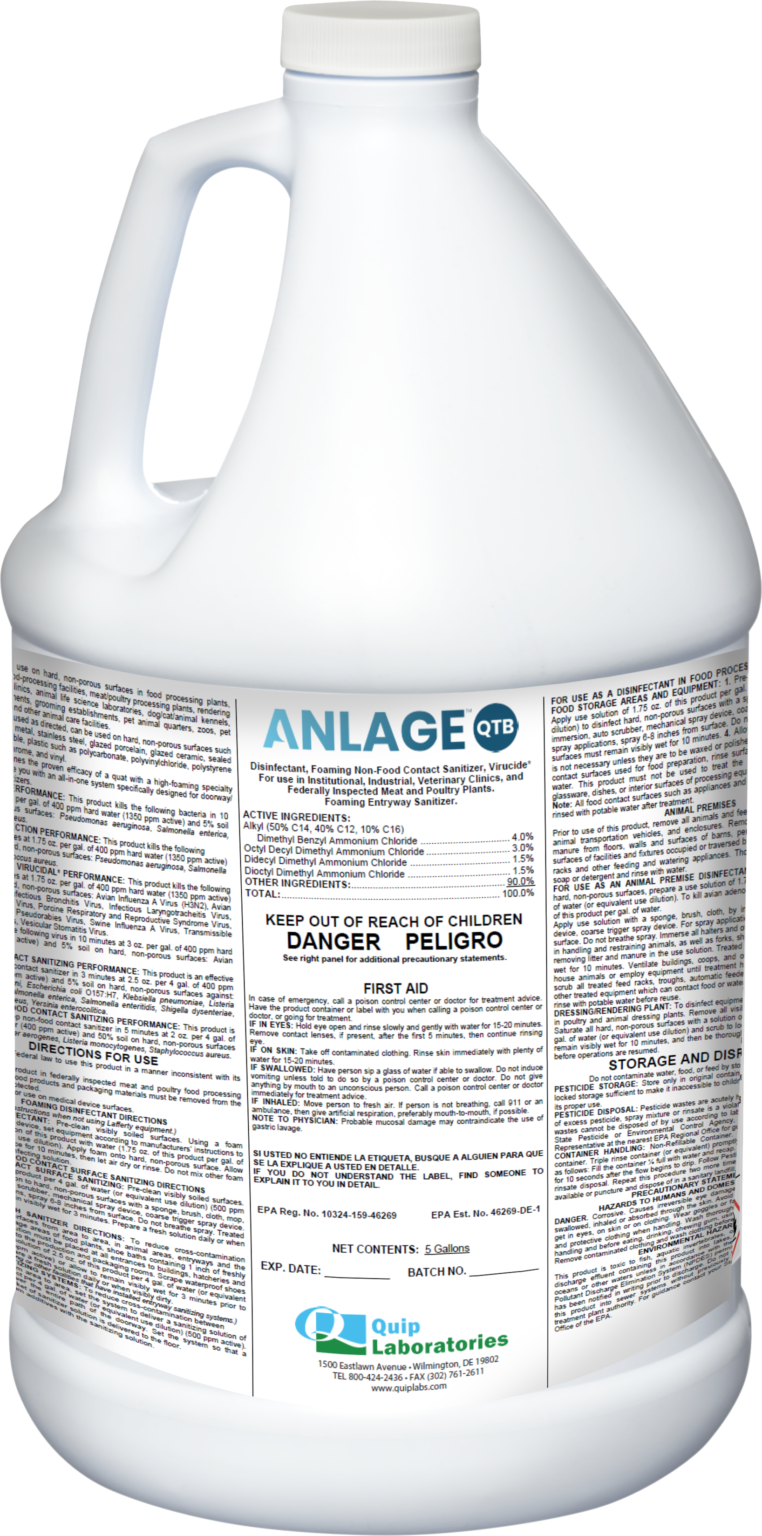
Anlage QTB | Ready-to-Use Disinfectant Spray

A ready-to-use, EPA-registered quaternary ammonium disinfectant spray for vivaria, animal life science laboratories, and veterinary clinics. Tuberculocidal, fungicidal, and effective against COVID-19 in 60 seconds — no dilution, no animal aversion.
Quat chemistry built for animal research environments — and the study variables that come with them
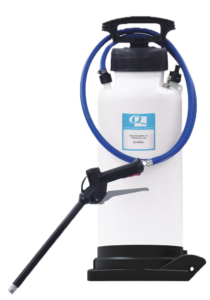
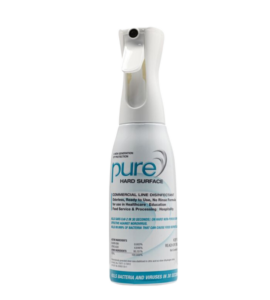
Anlage QTB is an EPA-registered, ready-to-use quaternary ammonium disinfectant and cleaner for vivaria, animal life science laboratories, and veterinary clinics. One step, no dilution — spray, wait, wipe.
Quaternary ammonium chemistry is the standard for research animal environments in part because of its behavioral profile: peer-reviewed research has shown no animal aversion to quat chemistry in mice or rats. The same study found significant aversion to a peroxide-based disinfectant — a finding that doesn't apply to all peroxide formulations, but does underscore why chemistry selection matters when behavioral stability is part of the study design.
Anlage QTB removes dirt, grime, blood, urine, fecal matter, and other common soils in animal housing and veterinary settings — with odor elimination and no bleaching or abrasion of treated surfaces. All efficacy testing was conducted in the presence of 5% blood serum, reflecting real-world facility conditions.
Quat chemistry has been shown to cause no aversion in mice or rats. In the UCLA DLAM study, the comparator — a peroxide-based disinfectant — produced statistically significant aversion. This finding applies to that product class specifically, not all peroxide formulations, but it reinforces why chemistry selection is a study design consideration.
Registered tuberculocidal efficacy against Mycobacterium tuberculosis BCG — the gold standard benchmark for broad-spectrum disinfection in high-risk research and clinical environments.
Eliminates 99.9% of SARS-CoV-2 (USA-WA1/2020) on hard non-porous surfaces in just 60 seconds — EPA-registered under Reg. No. 1839-83-46269.
Meets the OSHA Bloodborne Pathogen Standard. Kills HIV-1, HBV, and HCV on pre-cleaned surfaces previously soiled with blood or body fluids.
Head-to-head: quat vs. a peroxide-based disinfectant in a real vivarium
UCLA's Division of Laboratory Animal Medicine (DLAM) conducted a comprehensive evaluation comparing quaternary ammonium and a peroxide-based disinfectant chemistry across 10 buildings and 38,000 rodent cages. The study addressed efficacy, behavioral impact on animals, surface residue, and operational cost — every dimension that matters in a working vivarium.
The trigger for the study was a finding that 48% of facility floors were failing ATP benchmarks with the facility's existing chemistry. UCLA evaluated both chemistries across four test groups using cotton and microfiber mop heads, collecting ATP samples before and after mopping in four animal rooms over three weeks.
Mice showed statistically significant aversion to the peroxide-based product (p < 0.0001). Rats trended toward aversion as well. Both species showed no preference or aversion to quaternary ammonium — in any strain tested.
Bryant Volpe et al., AALAS Poster P209. Division of Laboratory Animal Medicine & Behavioral Testing Core, UCLA.Beyond behavioral impact, quaternary ammonium outperformed on every operational dimension: no surface residue, no foaming, and 1.25 oz per application versus 2–8 oz for the peroxide-based product. Quaternary ammonium with microfiber mops was selected as the UCLA DLAM facility-wide standard.
View the Full Study SummaryHead-to-head results: quaternary ammonium vs. peroxide-based disinfectant
| Parameter | Quaternary Ammonium | Peroxide-Surfactant |
|---|---|---|
| No animal aversion — mice | ✓ | ✕ |
| No animal aversion — rats | ✓ | ✕ |
| No surface residue | ✓ | ✕ |
| No foaming | ✓ | ✕ |
| Technician preference | ✓ | ✕ |
| Use rate | 1.25 oz/gal | 2–8 oz/gal |
| ATP reduction with microfiber mop | ✓ | ✓ |
| Selected as facility-wide standard | ✓ | ✕ |
Anlage QTB is EPA-registered for efficacy against a broad spectrum of bacteria, antibiotic-resistant organisms, viruses, and fungi. All testing conducted in the presence of 5% blood serum (organic soil) using AOAC test methods under Good Laboratory Practices (GLPs).
Bacteria
| Organism | Contact Time |
|---|---|
| Pseudomonas aeruginosa (ATCC 15442) | 3 min |
| Staphylococcus aureus (ATCC 6538) | 3 min |
| Salmonella (choleraesuis) enterica (ATCC 10708) | 3 min |
| Escherichia coli (ATCC 11229) | 3 min |
| Escherichia coli O157:H7 (ATCC 43895) | 3 min |
| Streptococcus pyogenes — Necrotizing Fasciitis (Group A) | 3 min |
| Listeria monocytogenes (ATCC 35152) | 3 min |
| Yersinia enterocolitica (ATCC 23715) | 3 min |
| Enterococcus faecium (ATCC 6569) | 3 min |
| Corynebacterium ammoniagenes (ATCC 6871) | 3 min |
| Salmonella (typhi) enterica (ATCC 6539) | 3 min |
| Shigella flexneri (ATCC 12022) | 3 min |
| Corynebacterium bovis (ATCC 7715) | 3 min |
| Shigella dysenteriae (ATCC 11835) | 3 min |
| Mycobacterium tuberculosis BCG (Tuberculocidal) | 3 min |
Antibiotic-Resistant Organisms
| Organism | Contact Time |
|---|---|
| Methicillin-Resistant Staphylococcus aureus (MRSA) (ATCC 33593) | 3 min |
| Vancomycin-Resistant Enterococcus faecalis (VRE) (ATCC 51575) | 3 min |
| Vancomycin-Intermediate Resistant S. aureus (VISA) (CDC 99287) | 3 min |
| Methicillin-Resistant S. epidermidis (MRSE) (ATCC 51625) | 3 min |
| Community-Associated MRSA — USA400 genotype (NRS 123) | 3 min |
| Community-Associated MRSA — USA300 genotype (NRS 384) | 3 min |
Viruses
| Virus | Contact Time |
|---|---|
| SARS-Related Coronavirus 2 (SARS-CoV-2) — COVID-19 virus (BEI NR-52281) | 1 min |
| HIV-1 (associated with AIDS) | 1 min |
| Influenza A Virus H1N1 (ATCC CCL-34) | 1 min |
| Norovirus (Norwalk virus) | 30 sec |
| Feline Calicivirus (ATCC VR-782) | 30 sec |
| Rabies Virus | 30 sec |
| Hepatitis B Virus (HBV) | 1–5 min |
| Hepatitis C Virus (HCV) | 1–5 min |
| Duck Hepatitis B Virus (DHBV) | 1–5 min |
| Bovine Viral Diarrhea Virus (BVDV) | 1–5 min |
| Avian Influenza A — H3N2 (ATCC VR-2072) | 2 min |
| Avian Influenza A — H9N2 | 2 min |
| Human Coronavirus (ATCC VR-740) | 2 min |
| SARS-Associated Coronavirus | 2 min |
| Paramyxovirus / Mumps (ATCC VR-1438) | 3 min |
| Rhinovirus type 39 (ATCC VR-340) | 3 min |
| Rotavirus (ATCC VR-2018) | 3 min |
| Canine Parvovirus (ATCC VR-2017) | 10 min |
| Poliovirus Type 1 (ATCC VR-1000) | 10 min |
| Hepatitis A Virus (HAV) (University of Ottawa) | 10 min |
Fungi
| Organism | Contact Time |
|---|---|
| Trichophyton interdigitale (formerly T. mentagrophytes) — Athlete's Foot Fungus (ATCC 9533) | 10 min |
Anlage QTB is registered for use on all hard, non-porous surfaces in animal research and veterinary environments. Because it is ready-to-use, it integrates cleanly into spray bottle workflows — no dilution station, no chemistry training required for staff, and no concentration variability from room to room.
Primary registered environments
Vivaria & Animal Research Centers
Holding room floors, walls, and corridors; cage wash areas; procedure rooms; and environmental monitoring–validated spaces. Quat chemistry is validated for no animal aversion — keeping behavioral variables out of your study design.
Animal Life Science Laboratories
Counters, biosafety cabinets, equipment surfaces, cages, crates, and animal equipment in biomedical and pharmaceutical research settings. Broad pathogen coverage relevant to common research models.
Veterinary Clinics & Animal Hospitals
Exam tables, kennels, surgical prep areas, ICU surfaces, and facility floors. Efficacy claims include pathogens highly relevant to companion animal environments — including Canine Parvovirus, Feline Calicivirus, and Rabies Virus.
Pet Shops & Boarding Facilities
Kennels, retail floors, grooming areas, and animal housing surfaces where rapid, no-mix disinfection between animals is essential to preventing cross-contamination.
Healthcare & Research Facilities
Patient rooms, operating rooms, ICU areas, locker rooms, and high-touch surfaces in hospitals and nursing homes where bloodborne pathogen and tuberculocidal coverage is required.
Additional Registered Uses
Food processing plants (non-food-contact surfaces; potable water rinse required on food-contact surfaces), transportation terminals, manufacturing facilities, schools, and general institutional settings.
Registered surface types (partial list)
- Floors
- Walls & ceilings
- Metal surfaces
- Stainless steel
- Glazed porcelain
- Glazed ceramic tile
- Plastic surfaces
- Chrome
- Brass & copper
- Laminated surfaces
- Baked enamel
- Countertops
- Sinks & basins
- Shower stalls & tubs
- Cages, crates & kennels
- Animal equipment
- Cabinets
- Garbage bins & cans
- Restroom fixtures
- Appliances
For plastic and painted surfaces, spot test on an inconspicuous area before use. See the full product label for the complete list of registered surfaces and use instructions.
Product documentation
Safety Data Sheet (SDS)
Complete safety information, handling requirements, disposal instructions, and regulatory data for Anlage QTB.
Download SDS (PDF)Efficacy Sheet
Full EPA-registered efficacy claims for Anlage QTB, including all pathogens, contact times, and use conditions.
Download Efficacy Sheet (PDF)Data Sheet
Concise product overview including key features, active ingredients, application guidance, and contact information.
Download Data Sheet (PDF)UCLA vivarium disinfection study
Read the full AALAS poster comparing quat and a peroxide-based disinfectant across 38,000 cages — ATP data, behavioral assays, and validated protocols.
Browse all disinfectants
Explore the full Quip Labs line of EPA-registered disinfectants and cleaners for laboratory, veterinary, and animal care use.
Need a concentrate?
Sani-Plex 128M is our EPA-registered concentrate disinfectant for laboratory and veterinary environments — ideal for high-volume or automated delivery programs.
Frequently asked questions
Ready to put Anlage QTB to work in your facility?
Our biosafety account managers can review your disinfection protocol, assess your pathogen exposure profile, and confirm that Anlage QTB — or another chemistry in our line — is the right fit for your research environment.
Send us a message
Need a quote? Ready to order? Just want to say hi? Fill out the form!
"*" indicates required fields